How to Measure Brand Visibility in ChatGPT, Claude, Gemini and Perplexity
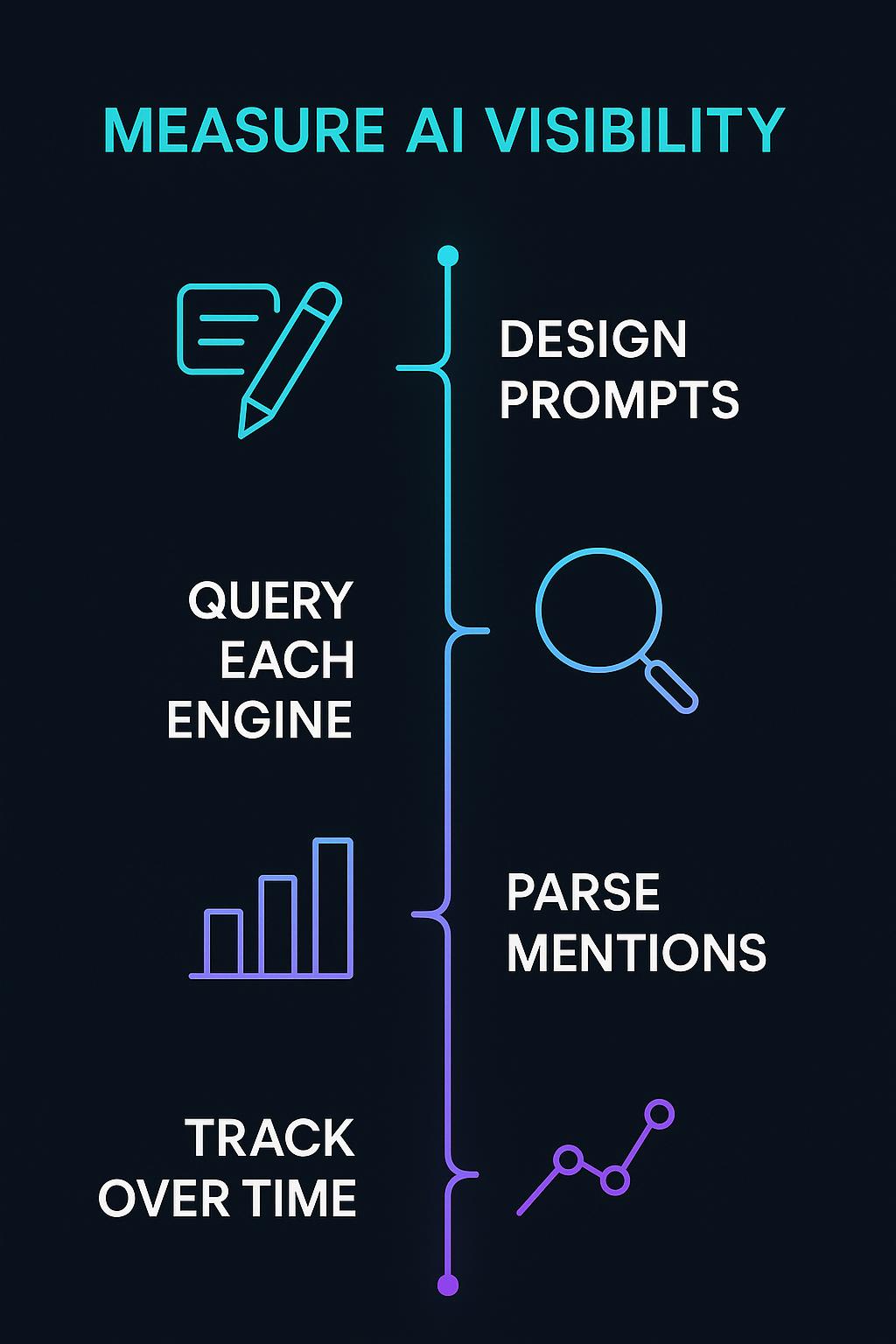
Measuring your brand's presence in AI answer engines requires a structured, repeatable methodology — not a single query. This guide covers prompts, sampling, competitive benchmarking, and reading results directionally.
Why Measurement Comes Before Optimisation
Before you can improve your brand's AI visibility, you need a credible baseline. That means moving beyond ad-hoc queries — typing your brand name into ChatGPT and noting whether it appears — toward a structured programme that produces data you can act on over time.
This article outlines a practical measurement methodology for four widely used AI answer platforms: ChatGPT, Claude, Gemini, and Perplexity. The principles extend to any AI engine you choose to include. Throughout, one caveat bears constant emphasis: AI answers are probabilistic and non-deterministic. The same prompt, submitted twice in the same session, can return materially different responses. Any measurement programme must account for this variance rather than pretend it does not exist.
Step 1: Design Representative Prompts
The foundation of any measurement programme is the prompt library. Prompts should mirror the questions your target buyers actually ask AI engines — not brand-name queries, which test recognition rather than organic authority.
Buyer-intent prompt categories to model:
- Category discovery — "What is the best [product category] for [use case]?" These surface which brands an engine considers relevant to a market.
- Comparison — "Compare [your brand] with [competitor A] and [competitor B]." These reveal how the engine characterises your positioning.
- Problem-solution — "How do I solve [problem your product addresses]?" These test whether your brand is cited as a solution provider.
- Credibility — "Which [category] companies are trusted by [target segment]?" These probe authority and reputation signals.
A working prompt library for a single brand typically contains a few dozen prompts distributed across these categories. Rotate in fresh prompts periodically to avoid over-indexing on a narrow slice of the engine's knowledge. Prompts should be written in the voice of a real buyer, not a search operator — AI engines respond very differently to natural-language questions than to keyword strings.
Step 2: Understand Why Engines Differ
ChatGPT, Claude, Gemini, and Perplexity are not interchangeable. Each has a distinct training corpus, retrieval architecture, and update cadence. Measuring across all four is necessary because a brand that appears prominently in one may be almost absent from another.
Key differences that affect measurement:
- Retrieval versus parametric knowledge. Some engines perform live web retrieval on most queries; others draw primarily on training data with optional browsing enabled. A brand with strong recent press coverage benefits more from retrieval-augmented engines.
- Training cutoffs. Models have knowledge cutoffs, which means recent brand activity may not yet be reflected in parametric answers. Factor this into your interpretation.
- Response style. Some engines tend toward structured, list-based answers; others lean toward analytical prose. The same brand may appear in a bulleted list on one engine but in a sentence on another, affecting how you count and score mentions.
- Citation behaviour. Some engines surface inline citations; others append sources only in browsing mode; others typically do not cite URLs by default. This shapes how you measure the citation dimension of visibility.
This is why generative engine optimization must be treated as a multi-platform discipline from the outset. Optimising for one engine without tracking the others creates a blind spot.
Step 3: Define the Metrics You Are Tracking
Consistency requires a defined metric set. The table below describes the five core dimensions of an AI visibility measurement programme.
| Metric | Definition | What it signals |
|---|---|---|
| Mention rate | Share of prompts in which your brand is named at least once | Baseline presence across the engine's knowledge surface |
| Share of mentions | Your brand mentions as a proportion of all brand mentions in the same prompt set | Relative visibility versus the competitive set |
| Sentiment | Qualitative tone of mentions (positive / neutral / cautious / negative) | How the engine characterises your brand when it does appear |
| Platform coverage | Number of distinct engines in which your brand appears across the prompt library | Breadth of AI presence |
| Position-in-answer | Whether your brand appears first, mid-list, or at the end of a response | Prominence, not just presence |
Two important notes on these metrics. First, mention rate and share of mentions are directional signals, not deterministic rankings. A given mention rate on a given day reflects what the engine surfaced during that sampling run — it does not mean you are "ranked" in any stable, algorithmic sense. Second, position-in-answer is the most fragile of the five: list ordering in AI responses fluctuates more than presence does, so treat it as a rough indicator rather than a precise standing.
Step 4: Sample Across Platforms and Time
A single measurement run is a photograph; a programme is a film. Because AI answers vary between runs, a single snapshot tells you very little about trends. You need multiple observations over time, taken under consistent conditions.
Sampling discipline:
- Run your full prompt library against each platform on a fixed cadence — weekly for active campaigns, monthly for baseline monitoring.
- Record the date, time, and any known model or product updates. Model updates can shift results significantly and should be treated as potential breakpoints in your trend series.
- Submit each prompt more than once per run and note variance. If your mention rate swings widely between two identical prompt submissions in the same session, that variance itself is a data point — it suggests the engine is uncertain about your brand's relevance.
Step 5: Track Competitors and Share of Mentions
AI visibility is always relative. An engine that mentions your brand in a given share of category prompts looks very different depending on whether your closest competitor appears far more or far less often in the same prompts.
Build a competitive set of several brands and run them through the same prompt library in parallel. This produces your share-of-mentions figure — arguably the most actionable metric in the programme, because it shows whether your visibility is improving in absolute terms, or simply keeping pace with (or falling behind) competitors.
When tracking competitors, also examine which prompts surface each brand. A competitor that dominates problem-solution prompts but is absent from comparison prompts has a different knowledge profile than a brand that appears evenly. These asymmetries reveal where you are winning and losing the AI conversation.
Step 6: Read the Citations
For engines that surface citations, the source list is highly informative. It reveals which content assets the engine is using to construct its answer about your category.
Examine citation patterns for:
- Domain authority of cited sources. Trade publications, analyst reports, and reference sources tend to carry more weight in training and retrieval than thin commercial pages.
- Recency of cited content. Retrieval-augmented engines prefer recent material. If your brand's most cited asset is years old, content freshness is a gap.
- Competitor citations. Note which of your competitors' assets are being cited and in what contexts. This maps the content gap between your programme and theirs.
Citations are not available on all engines in all query types. Where they are unavailable, qualitative analysis of the response language can still indicate which source types the engine is drawing on.
Step 7: Account for Geography
AI engines do not return identical answers globally. Retrieval-augmented engines surface locally relevant web content; parametric models reflect the geographic distribution of their training data. A brand with strong presence in one market may appear frequently in that locale's queries and be absent from another.
If your brand operates across multiple regions, your measurement programme should sample each significant region separately. This means either using locale-specific sessions or platforms that support region parameterisation. Do not extrapolate from a single geography to global visibility — the gap between markets can be substantial.
Step 8: Interpret Directionally, Not Definitively
This step is as much about analytical culture as methodology. The temptation, when measurement produces numbers, is to treat those numbers as precise and stable. With AI visibility data, that temptation should be resisted.
What you can claim with confidence:
- Your brand is consistently present (or absent) in a category of prompts on a given engine.
- Your share of mentions has moved in a particular direction over a defined measurement window.
- A specific competitor is systematically more prominent in a specific prompt category.
What you cannot claim:
- That your brand is "ranked N" on any engine in any stable algorithmic sense.
- That a single measurement run reflects a persistent state.
- That improvements in one engine will transfer automatically to others.
AI engines update continuously. A brand that invests in high-quality content, strong domain authority, and clear entity disambiguation across structured and unstructured web sources tends to see visibility improve over time across multiple engines — but the relationship is not deterministic and the lag can be weeks to months.
Getting Your Baseline
The practical starting point for any brand is an initial visibility snapshot: run your prompt library once across the major engines, record the results against the five metrics above, and establish the competitive context. This is your baseline.
From there, the work of generative engine optimization becomes a cycle: measure, identify gaps, publish content that closes those gaps, re-measure, and adjust.
If you want to see where your brand stands today without building the entire infrastructure from scratch, the free AI visibility snapshot from ApexGEO runs your brand through a structured prompt set across major AI engines and returns a baseline read — mention presence, competitive context, and directional signals — so you have a data-grounded starting point rather than an anecdotal one.
Q: Do I need to measure all four engines, or can I focus on just one?
A: You should sample at least three engines before drawing conclusions. Each platform has a distinct retrieval architecture, training corpus, and update cadence. A brand with strong visibility in one may barely register in another. Focusing on one engine gives you a partial picture and can produce decisions — such as content investments — that do not generalise across the AI search landscape your buyers actually use.
Q: Are AI rankings deterministic? If I appear first in a response today, am I "ranked first"?
A: No. AI answers are probabilistic: the same prompt submitted twice to the same engine can return a different order, different brands, or a different response structure entirely. Position-in-answer is a directional signal worth tracking over multiple runs, but it does not represent a stable algorithmic rank in the way a search engine results page position does. Treat all AI visibility metrics as sampled estimates with inherent variance, not fixed standings.
Q: How often should I re-run my measurement programme?
A: For brands in active visibility-building programmes, a weekly cadence provides enough resolution to detect meaningful shifts without excessive noise. For brands in a monitoring posture, monthly is a reasonable minimum. In both cases, flag any known model updates from the major platforms as potential breakpoints in your trend series — a shift in results after a major release is likely structural, not indicative of a change in your brand's web presence.
Q: What is the single most important metric to start with?
A: Mention rate across your buyer-intent prompt library is the cleanest starting point. It tells you, in simple terms, whether the engines your buyers use are surfacing your brand when they ask relevant questions. Once you have a mention-rate baseline for yourself and your nearest competitors, share of mentions becomes the primary ongoing metric — it contextualises your absolute presence within the competitive landscape and is the number most directly tied to strategic outcomes.