AI Visibility Score: What It Should and Should Not Mean
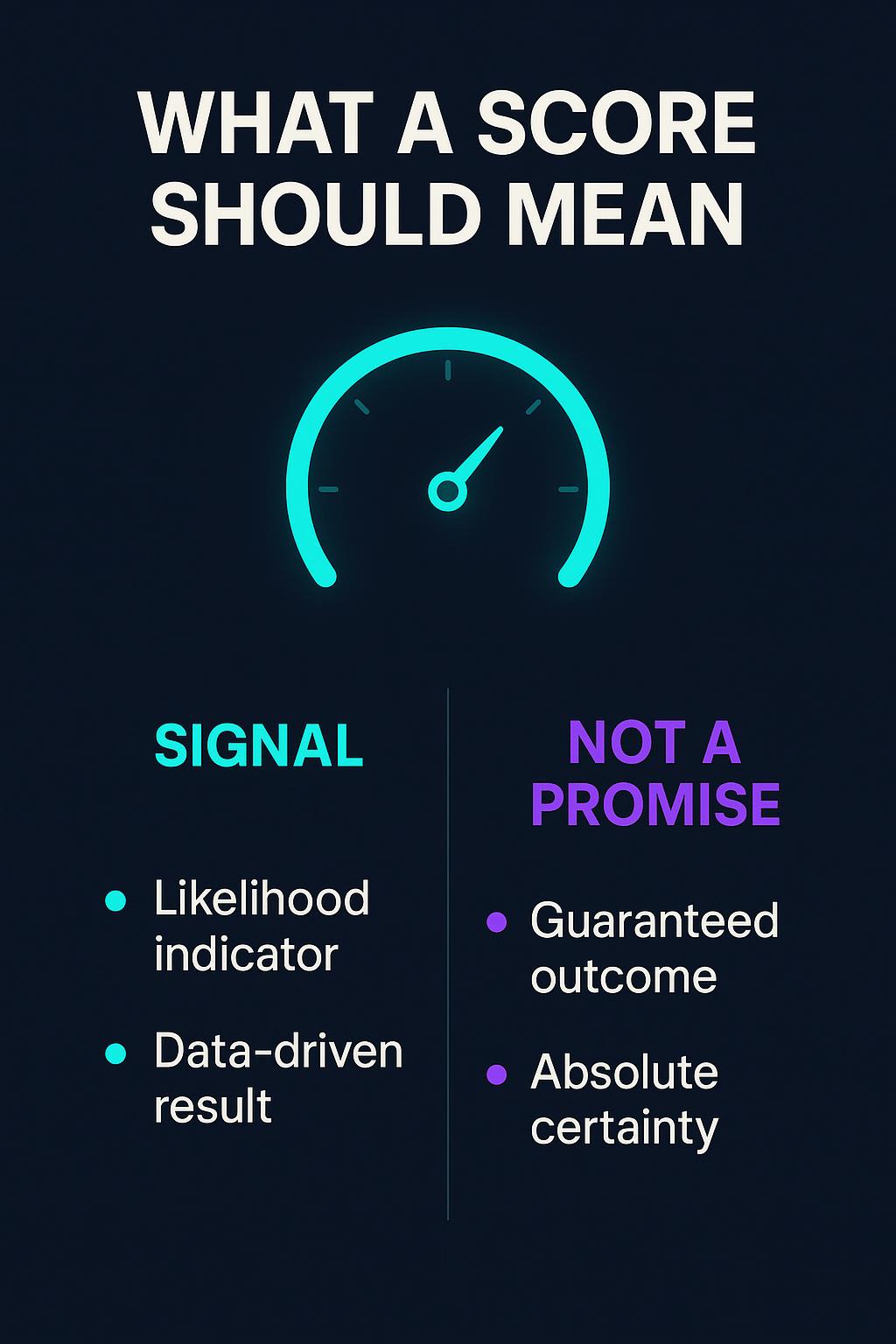
AI visibility scores are directional signals, not ranking guarantees. This guide explains what a credible score should measure, what red flags to avoid, and how to connect your score to real improvements.
The Metric Everyone Wants, and the Traps That Come With It
Every marketing leader wants a number. A single figure that answers the question: "How visible is our brand when people ask AI systems for recommendations?"
That demand is legitimate. AI visibility is now a real commercial concern. When a prospect asks ChatGPT, Claude, or Perplexity which platform to use, whether your brand appears — and how it appears — directly affects pipeline. The instinct to measure it is correct.
The danger is in what some vendors do with that instinct. Scores get manufactured. Weights get invented. Benchmarks get fabricated. And marketing leaders end up optimising for a number that has no meaningful relationship with how AI systems actually surface brands.
This article is about building a more disciplined relationship with AI visibility scoring: what a credible score should include, what it should never promise, and how the score connects to an improvement loop that actually moves results.
What a Useful AI Visibility Score Should Measure
A score without defined inputs is just a number. A credible AI visibility score draws from several distinct signal categories, each measuring a different dimension of how your brand appears in AI-generated answers.
Mention frequency across platforms
The most basic signal: how often does your brand appear in AI-generated responses to relevant queries? Frequency matters, but only when measured across a representative spread of platforms. A brand that appears frequently in one engine but is absent from several others has a narrower footprint than its frequency count suggests.
Platforms differ significantly in their response tendencies, their training data, and their citation behaviours. A score that aggregates across answer engine optimization targets — the major AI answer engines your buyers use — gives a more honest picture than one built on a single source.
Competitive share of voice
Absolute mention counts are less informative than relative ones. If your brand appears in a respectable share of relevant AI responses but your two closest competitors appear more often, your absolute frequency looks acceptable while your competitive position is weak.
A useful score contextualises brand mentions against the field. Share of voice across AI platforms is one of the cleaner ways to translate raw mention data into strategic relevance.
Sentiment and framing quality
Presence is not endorsement. AI systems sometimes mention a brand in a neutral or cautionary context — as a comparison point, as an example of what not to do, or with qualifications that undercut a recommendation.
Sentiment analysis on AI-generated mentions distinguishes between a brand being cited positively, neutrally, or negatively. A brand mentioned frequently but framed poorly may deserve a lower score than one mentioned less often but consistently positioned as a strong choice.
Platform coverage and depth
Not all platforms carry equal weight for a given audience. A B2B software brand needs strong coverage on the platforms enterprise buyers use for research. A consumer brand may prioritise different surfaces.
A credible score weights platform coverage in a way that reflects where a brand's target audience actually directs queries — not simply which platforms are easiest to measure.
Recency and trend direction
A snapshot score is less useful than a trend. A brand that scored well six months ago but whose mentions have declined steadily is in a weaker position than its current absolute score suggests. Conversely, a brand on an upward trajectory has positive momentum that a static number misses.
Trend direction — whether the score is improving, plateauing, or declining — is often more actionable than the score itself.
Linkage to specific recommendations
This is the signal most scoring systems omit. A score that cannot be connected to specific, prioritised actions is an observation, not a tool. The most useful scores are structured so that each component can be traced back to a recommendation: a content gap to fill, a citation opportunity to pursue, a technical issue on the brand's owned properties that is suppressing AI visibility.
For a fuller explanation of how these inputs are weighted and combined, see how the ApexGEO score works.
What an AI Visibility Score Should Not Be
Understanding what to avoid is as important as understanding what to include.
A single vanity number without component transparency
A score presented as a clean percentage with no breakdown is a warning sign. Without visibility into which components drove the score — and in which direction — there is no basis for knowing which actions to prioritise, or whether the score is moving for reasons that matter.
A ranking guarantee
No AI visibility score can guarantee that a brand will appear in AI-generated responses. AI systems are not search engines with deterministic ranking algorithms. They are probabilistic systems whose outputs depend on training data, query phrasing, user context, and model updates that are opaque and frequent.
Any vendor that presents a high score as a promise of AI placement is either misunderstanding how these systems work or misrepresenting them deliberately. Treat such claims as disqualifying.
A fabricated absolute
Invented numeric benchmarks are common and almost always meaningless unless the vendor can explain precisely how the benchmark was constructed, from what dataset, and with what confidence. In the absence of that explanation, the benchmark is decorative.
A credible score is honest about what it does not know. Directional comparisons — "your share of voice improved this month" or "your sentiment score is below the median in your tracked cohort" — are more defensible than invented absolute thresholds.
A metric divorced from your actual audience
A score built on queries that do not reflect how your real buyers actually use AI systems is measuring the wrong thing. The prompts used to generate the measurement data need to be calibrated to your category, your competitive set, and the way your audience frames their research questions.
The Score Is a Starting Point, Not a Destination
The practical value of an AI visibility score lies in what it triggers: a structured improvement loop.
A brand that scores poorly on platform coverage now has a prioritised target: create content that makes its expertise legible to the platforms where it is absent. A brand that scores well on frequency but poorly on sentiment has a different problem: the narrative around its brand in AI-accessible content may need correction or enrichment.
The loop looks roughly like this. Measure the current state across the signal categories described above. Identify which components are dragging the overall score. Prioritise the highest-leverage actions — whether that is publishing structured content, improving on-page clarity, building citations, or correcting factual gaps in how the brand is described across accessible sources. Implement. Measure again.
This is the core of answer engine optimization as a practice: treating AI visibility as an ongoing discipline, not a one-time audit.
ApexGEO tracks brand mentions, historical visibility trends, sentiment, and competitive share across major AI platforms, and surfaces recommendations tied directly to score components. The intent is not to hand marketers a number to report to leadership — it is to give them an action queue.
Start With a Baseline
Before optimising, you need to know where you stand. ApexGEO offers a free AI visibility snapshot for brands operating in South Africa and international markets — a structured look at how your brand currently appears across the core AI answer engines, with enough component detail to identify your highest-priority gaps. Take the free AI visibility snapshot and use it as the baseline from which your improvement loop starts.
Q: Is a higher AI visibility score guaranteed to produce more leads or revenue?
A: No. A higher score indicates stronger brand presence in AI-generated responses, which increases the probability that prospects encounter your brand during AI-assisted research. It is a leading indicator, not a conversion guarantee. The relationship between AI visibility and revenue depends on many downstream factors — query intent, competitive alternatives, brand perception, and the quality of your owned channels — that a visibility score cannot control or predict.
Q: How often should an AI visibility score be recalculated?
A: Weekly or monthly recalculation is appropriate for most brands. AI systems update their models and training data on irregular schedules, so very frequent recalculation introduces noise rather than insight. Monthly tracking provides enough resolution to identify meaningful trends and to evaluate whether recent content or optimisation activity has moved the needle. For brands running active optimisation campaigns, fortnightly tracking may be justified.
Q: Can a brand improve its AI visibility without producing new content?
A: Sometimes, but the ceiling is low. AI systems surface brands based on what is accessible, structured, and credible in their training data and real-time retrieval sources. Technical improvements — structured data, clearer entity definitions, citation-worthy page formats — can improve visibility without adding new content volume. But sustained improvement in competitive categories almost always requires content that clearly articulates expertise, answers the questions buyers are actually asking, and is distributed across sources that AI systems treat as authoritative.
Q: How do AI visibility scores differ from traditional SEO metrics?
A: Traditional SEO metrics — keyword rankings, domain authority, organic traffic — measure performance in deterministic, crawl-indexed systems where ranking signals are relatively stable and documented. AI visibility scores measure performance in probabilistic systems where outputs vary by query, model, and context. The inputs that drive AI visibility overlap partially with SEO inputs but are not identical. The two sets of metrics are complementary, not interchangeable.
Q: What should I do if my AI visibility score declines despite no changes on my end?
A: A decline without corresponding changes on your owned properties usually points to one of three causes: a competitor increased their visibility and displaced your share of voice; a model update changed how the category is described or which sources are weighted; or new content about your brand appeared in accessible sources and is framing the brand less favourably. Diagnosing which of these is driving the decline requires component-level data — frequency, sentiment, and competitive share separately — rather than relying on the aggregate score alone.