What Is Generative Engine Optimization (GEO)?
Learn what generative engine optimization is, how GEO differs from SEO, and how brands earn accurate citations across AI answer engines and search now.
Generative engine optimization (GEO) is the practice of making a brand's content, expertise and online presence easier for AI answer engines to retrieve, understand, cite and recommend when they generate answers. It is related to SEO, but it is not the same thing. SEO mainly optimises for visibility in search result pages. GEO optimises for visibility inside synthesised AI answers, citations, summaries and recommendations.
A practical GEO programme asks a simple question: when someone asks an AI system a commercially important question, does the answer mention, cite or trust your brand? If not, GEO improves the evidence available to that system: clear explanations, source-backed claims, structured pages, crawlable content, consistent entity information, and answers that are useful enough to quote.
The term has an academic foundation. In the 2024 KDD paper GEO: Generative Engine Optimization, researchers from Princeton University, Georgia Tech, The Allen Institute for AI and IIT Delhi describe generative engines as systems that retrieve documents and use large language models to generate responses grounded in sources. They introduce GEO as a creator-focused framework for improving the visibility of web content in generative engine responses and report that GEO methods can improve visibility by up to 40% in their benchmark. Their strongest practical finding is also common sense: content becomes more visible when it adds verifiable evidence, relevant citations, quotations, statistics where they genuinely apply, and clear language.
For African businesses, GEO matters because many buyers now begin discovery with ChatGPT, Gemini, Google AI Overviews, Perplexity, Claude, Copilot or industry-specific AI tools rather than a classic list of blue links. A brand can rank well on Google and still be absent from AI answers if its pages are thin, hard to crawl, weakly sourced, locally ambiguous or not phrased in ways that answer engines can confidently quote.
The short answer: GEO in one paragraph
Generative engine optimisation is a discipline for improving how often and how accurately a brand appears in AI-generated answers. It combines classic technical SEO, content strategy, entity clarity, source quality, structured data and measurement across AI platforms. Good GEO does not try to trick models. It makes the truth about a business easier to verify: what the business does, where it operates, why it is credible, what evidence supports its claims, and which pages should be cited for specific questions.
Why GEO exists: AI answers work differently from search results
Traditional search engines usually return a ranked list of pages. The user scans the results, chooses a link and evaluates the page directly. Generative engines compress that journey. They retrieve information, synthesise it into a single answer and may cite only a handful of sources. The user often sees the answer before seeing the source.
That changes what "visibility" means. In classic SEO, being position three for a query can still bring impressions and clicks. In an AI answer, visibility may depend on whether your content is selected as evidence, whether your brand is mentioned in the generated text, how prominently the citation appears and whether the answer uses your framing.
The academic GEO paper makes this point explicitly: generative engines combine information from multiple sources in a single response, so visibility is affected by factors such as the length of cited material, the uniqueness of the source's contribution and how the source is presented. This is why GEO is not just "SEO with AI keywords." It is about becoming a reliable input to generated answers.
Google's public guidance points in the same direction. Google says the best practices for SEO remain relevant for AI features such as AI Overviews and AI Mode, and that there are no special requirements to appear in those experiences. Google also advises site owners to focus on unique, satisfying, people-first content. In other words, GEO should not abandon SEO fundamentals. It should make those fundamentals stronger for a world where AI systems summarise, compare and cite sources.
GEO vs SEO: what is the difference?
GEO and SEO overlap, but they optimise for different moments in the discovery journey.
SEO focuses on helping pages get crawled, indexed, ranked and clicked in search engines. Important signals include technical accessibility, relevance, links, content quality, page experience, structured data and search intent alignment.
GEO focuses on helping a brand become a trustworthy source inside AI-generated responses. Important signals include crawlability, entity consistency, direct answers, citation-worthy claims, topical depth, freshness, clear authorship, external corroboration and machine-readable context.
A good way to separate them:
- SEO asks: "Can search engines find, understand and rank this page?"
- GEO asks: "Can an AI answer engine confidently use this page as evidence?"
The two should work together. If a page blocks crawlers, hides key information in scripts, lacks clear headings or has weak evidence, it will struggle in both search and AI answers. But GEO adds a second layer: the content must be easy to extract, quote, compare and verify.
What AI answer engines need before they cite a source
No public platform publishes a complete formula for citation selection, and responsible GEO should not pretend otherwise. But public documentation and observable product behaviour make several needs clear.
1. Crawlable, accessible pages
AI search systems still need access to content. OpenAI's crawler documentation says OAI-SearchBot is used to surface websites in ChatGPT search features and recommends allowing OAI-SearchBot in robots.txt if a site wants to appear in those results. OpenAI also distinguishes OAI-SearchBot for search from GPTBot for training, meaning publishers can make separate decisions about search visibility and model training.
Google's AI features also sit on top of Search systems. Google says SEO best practices remain relevant for AI Overviews and AI Mode. That means basics such as indexable pages, sensible URLs, descriptive titles, useful snippets, sitemaps, canonical handling and page performance still matter.
2. A direct answer to the user's question
AI systems often answer specific, natural-language queries. A page that buries the answer under marketing copy is harder to use. The best GEO pages answer the main question near the top, then expand into definitions, examples, steps, caveats and evidence.
For the query "What is generative engine optimization?", the answer should not begin with a vague promise to "unlock AI visibility." It should define GEO plainly, explain why it exists, compare it with SEO and give practical examples of what to change.
3. Verifiable claims and sources
The KDD GEO paper evaluated methods such as adding citations, quotations and statistics where appropriate. It reported that including citations, quotations from relevant sources and statistics can significantly improve source visibility across queries. That does not mean every article should be stuffed with numbers. It means AI systems need evidence. If you make a factual claim, support it with a credible source or avoid the claim.
For businesses, this is especially important in regulated or high-trust sectors such as finance, healthcare, infrastructure, education and legal services. GEO content should be careful, sourced and precise.
4. Clear entities and consistent brand facts
An AI system has to understand which entity a page is about. That includes the company name, locations served, products, leadership where relevant, industry category, contact channels, credentials and relationship to other entities. Inconsistent names, old addresses, conflicting service pages and duplicated thin profiles create ambiguity.
For African brands, local context matters. A logistics company operating in South Africa, Kenya and Nigeria should say that clearly. A B2B SaaS company serving "Africa" should identify the actual markets, currencies, compliance concerns, integrations or customer profiles it supports. GEO rewards specificity because specificity is easier to cite.
5. Structured content that is easy to extract
Headings, short definitions, tables, bullet lists, FAQs, schema markup and descriptive image alt text all help machines and humans parse content. Google says structured data is useful for sharing information about content in a machine-readable way that its systems consider. Structured data does not guarantee inclusion in AI results, but it reduces ambiguity.
The structure should reflect real user questions:
- What is GEO?
- How is GEO different from SEO?
- Which platforms matter?
- How do you measure AI visibility?
- What should a business do first?
What does a GEO strategy include?
A useful GEO strategy has six parts.
1. Query and prompt research
Start with the questions that matter commercially. These are not always short SEO keywords. They are prompts such as:
- "Who are the best fibre network planning consultants in South Africa?"
- "What software helps African brands monitor AI visibility?"
- "Which cybersecurity firms serve mid-market companies in Johannesburg?"
- "What is generative engine optimization?"
Track whether AI platforms mention the brand, which competitors appear, which sources are cited and what wording the answers use. This creates a gap map: prompts where the brand should be visible but is not.
2. Evidence-led content creation
Each important prompt needs a page that answers it better than the sources currently being cited. Better does not mean longer by default. It means clearer, more complete, more current and more verifiable.
A strong GEO article usually includes:
- a direct answer in the first few paragraphs;
- definitions written in plain language;
- sources for external claims;
- practical examples;
- limitations and caveats;
- a summary or checklist;
- FAQ pairs that mirror real prompts.
3. Entity and authority clean-up
Make sure brand facts are consistent across the website, Google Business Profile where relevant, social profiles, product pages, directories, press mentions, partner pages and documentation. AI systems can be conservative when an entity is unclear.
Authority does not require inflated claims. It requires verifiable proof: case studies, public documentation, named experts, customer categories, certifications, original research, product screenshots, methodology pages and transparent contact information.
4. Technical access for search and AI crawlers
Review robots.txt, sitemaps, canonical tags, server responses, JavaScript rendering, paywalls and CDN blocking. If a brand wants visibility in ChatGPT search, OpenAI's documentation specifically recommends allowing OAI-SearchBot. If a brand wants Google visibility, Google's normal crawling and indexing requirements still apply.
This is an area where teams often make accidental mistakes. A site can publish excellent content and still be invisible if important pages are blocked, redirected incorrectly, too slow, duplicated or not linked internally.
5. Platform-by-platform monitoring
GEO is measured by prompts and platforms, not just by rankings. A brand should monitor answers across the AI systems its buyers use. At minimum, track:
- whether the brand is mentioned;
- whether the brand is cited;
- which URL is cited;
- the sentiment or framing of the mention;
- which competitors appear;
- whether the answer is accurate;
- whether the source page has changed since the last run.
The ApexGEO approach is built around this visibility gap: identify prompts where a brand should be present, compare AI platforms, then create or improve evidence that can be cited truthfully.
6. Continuous improvement
AI answers change. Search indexes update. Competitors publish new pages. Models and retrieval systems evolve. GEO should therefore be a cycle: monitor, research, publish, verify, improve and repeat.
What should you optimise on a page for GEO?
A page written for GEO should be useful to a person first and easy for machines to parse second. The following checklist is practical and safe:
- Put the answer first. Define the concept or answer the question before the sales pitch.
- Use descriptive headings. Headings should be real questions or claims, not vague slogans.
- Add credible sources. Link to primary documentation, academic papers, standards bodies or official platform guidance.
- Avoid unsupported statistics. If a number cannot be verified, do not use it.
- Include original perspective. Explain what the information means for your market, customer or use case.
- Clarify the entity. State who the brand is, what it does and where it operates.
- Use schema where appropriate. Article, Organization, FAQPage, Product, LocalBusiness and other schema types can clarify content for search systems when used correctly.
- Keep important content in HTML. Do not hide critical facts inside images, inaccessible scripts or downloadable files only.
- Refresh pages when facts change. AI answers can cite outdated pages if they remain online and authoritative.
- Measure answer visibility. Check whether the page actually changes AI mentions and citations over time.
What GEO is not
GEO is not a shortcut for weak brands. It is not keyword stuffing, fake statistics, AI-spun pages or hidden text for crawlers. The KDD paper tested keyword stuffing as one possible method, but responsible businesses should be cautious: adding keywords without improving usefulness does not create reliable evidence and can damage trust.
GEO is also not only for global software companies. Local and regional businesses can benefit because AI tools often answer local buying questions. A South African manufacturer, a Kenyan fintech, a Nigerian logistics provider or a pan-African B2B SaaS company can all lose opportunities if AI answers mention only global brands or outdated directories.
Most importantly, GEO is not separate from reputation. If trustworthy third-party sources, customer proof and clear documentation do not exist, an AI answer engine has less reason to mention the brand. Publishing one article is useful, but building a verifiable footprint is stronger.
How to measure GEO performance
The simplest GEO metric is mention rate: the percentage of tested AI answers that mention the brand for a target prompt set. A more advanced measurement system also tracks citation rate, cited URLs, competitor mentions, answer accuracy and platform differences.
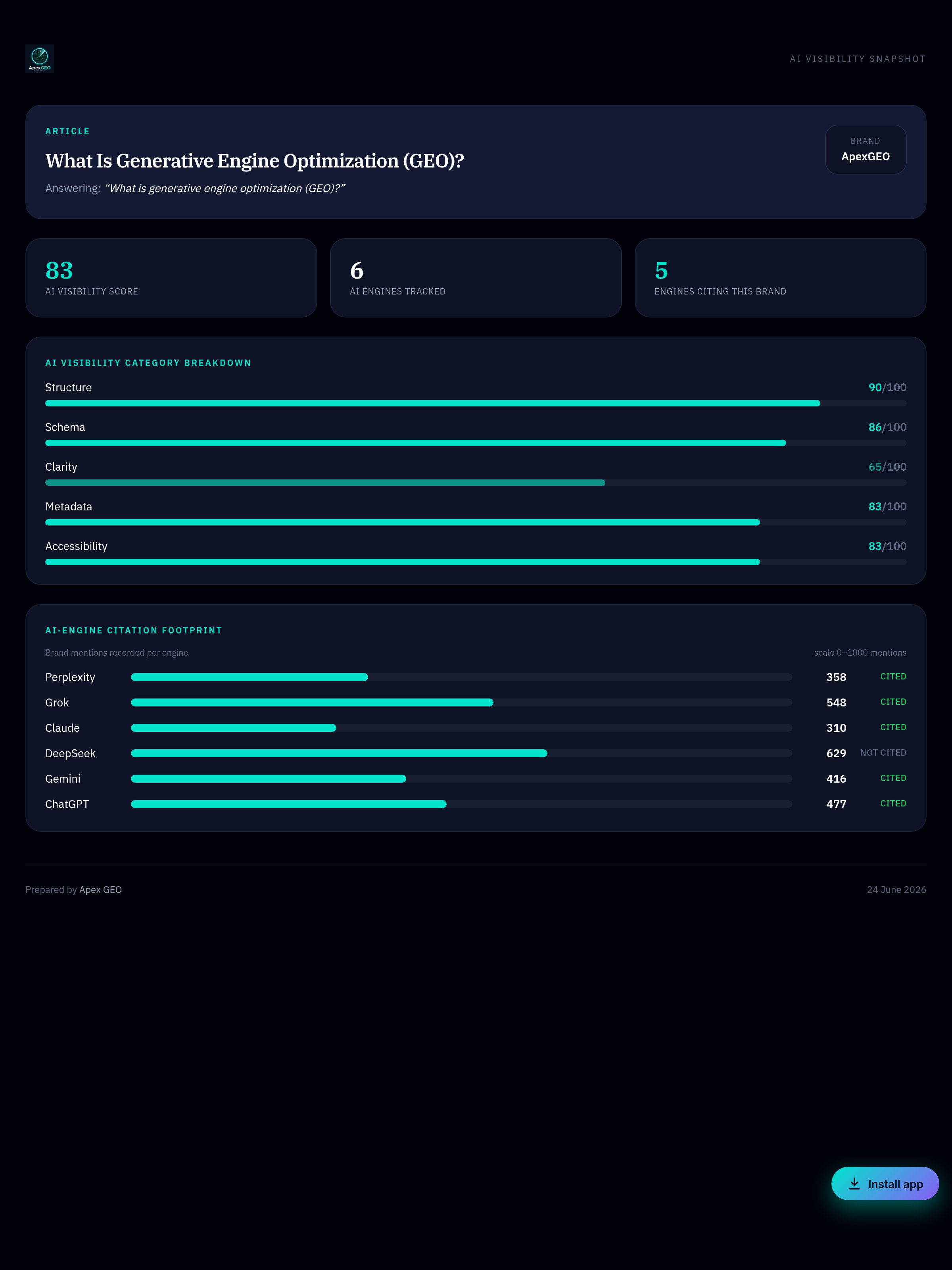
For example, if a brand tests the prompt "What is generative engine optimization?" across ChatGPT, Gemini, Perplexity, Claude and other engines, it can record whether each system mentions the brand, which sources are cited and whether the answer uses the brand's preferred explanation. If the brand is absent from every platform, the next step is not guessing. It is researching what answers currently cite, identifying what those sources do well and publishing a better, more verifiable answer.
GEO measurement should be honest. If a platform does not cite your page, record that. If the answer is wrong, record the inaccuracy. If a competitor is cited because it has stronger evidence, treat that as a content and authority gap rather than a platform failure.
A practical 30-day GEO plan
Here is a realistic first month for a business starting GEO.
Week 1: Build the prompt map. List 20 to 50 questions buyers ask before choosing a provider. Include educational, comparison, local and vendor-selection prompts. Run them across the AI platforms your audience uses. Capture mentions, citations and competitors.
Week 2: Fix technical access and entity basics. Review robots.txt, sitemaps, indexability, structured data, key service pages, author pages and organisation information. Make sure AI and search crawlers can access the pages you want surfaced.
Week 3: Publish evidence-led pages. Choose the biggest gaps and publish pages that directly answer those prompts. Use primary sources, clear headings, local context, examples and FAQs. Avoid unsupported claims.
Week 4: Re-test and refine. Run the same prompts again. Compare mention rate, citation rate and answer accuracy. Improve pages that are still not being used. Add internal links, update schema and strengthen external proof where needed.
This cycle will not guarantee instant AI citations. No honest GEO provider should promise that. But it gives brands a disciplined way to improve the evidence that AI systems can discover and use.
Take the Next Step
If you want to see where your brand currently stands across AI answer engines, ApexGEO offers a free AI visibility snapshot that shows where you are cited, where you are absent, and where the largest opportunities lie. Get your free AI visibility snapshot and start measuring what traditional rank trackers cannot show.
Q: What is generative engine optimization in simple terms?
A: Generative engine optimisation is the process of improving your content and online presence so AI answer engines can find, understand, cite and recommend your brand when they generate answers.
Q: Is GEO replacing SEO?
A: No. GEO builds on SEO. Technical crawlability, helpful content, structured data and authority still matter. GEO adds a focus on AI-generated answers, citations, brand mentions and prompt-level visibility.
Q: Which platforms does GEO apply to?
A: GEO applies to AI answer and search experiences such as ChatGPT search, Google AI Overviews and AI Mode, Perplexity, Gemini, Claude, Copilot and industry-specific AI assistants. The exact visibility signals differ by platform.
Q: What makes content citation-worthy for AI systems?
A: Citation-worthy content gives a direct answer, uses clear structure, supports factual claims with credible sources, avoids invented statistics, identifies the relevant entity clearly and offers specific information that other pages do not.
Q: How do you measure GEO success?
A: Measure GEO by tracking target prompts across AI platforms. Useful metrics include brand mention rate, citation rate, cited URLs, competitor mentions, answer accuracy and whether the answer reflects the brand's current facts.