What Is AI Search Visibility?
AI search visibility determines whether your brand appears in answers from ChatGPT, Claude, Gemini, and Perplexity. Learn why it matters and how to improve it.
What Is AI Search Visibility?
When a potential buyer types a question into ChatGPT or Perplexity rather than Google, something significant has shifted. They are not searching for a list of links to evaluate — they are asking for a recommendation. The answer they receive either includes your brand or it does not. That inclusion, or absence, is what AI visibility is about.
The Shift in How Buyers Discover Brands
Search behaviour has been changing gradually, then all at once. For years, the dominant model was straightforward: a user typed a query, a search engine returned ten blue links, and the user clicked through to websites. Brands competed for those positions through traditional SEO — title tags, backlinks, page speed, and structured data.
AI-powered answer engines work differently. When a user asks "Which project management tool is best for a remote team?" or "What CRM should a B2B agency use?", the engine synthesises information from across the web and delivers a direct, conversational answer. It names products. It describes trade-offs. It makes recommendations.
Buyers — particularly in B2B and considered-purchase categories — are adopting this pattern because it compresses research time dramatically. Instead of opening fifteen tabs and reading fifteen articles, they receive a synthesised perspective in seconds. The implication for brands is stark: if the AI does not know your brand well enough to include it, you are invisible at a critical moment in the buyer's journey.
What AI Search Visibility Actually Means
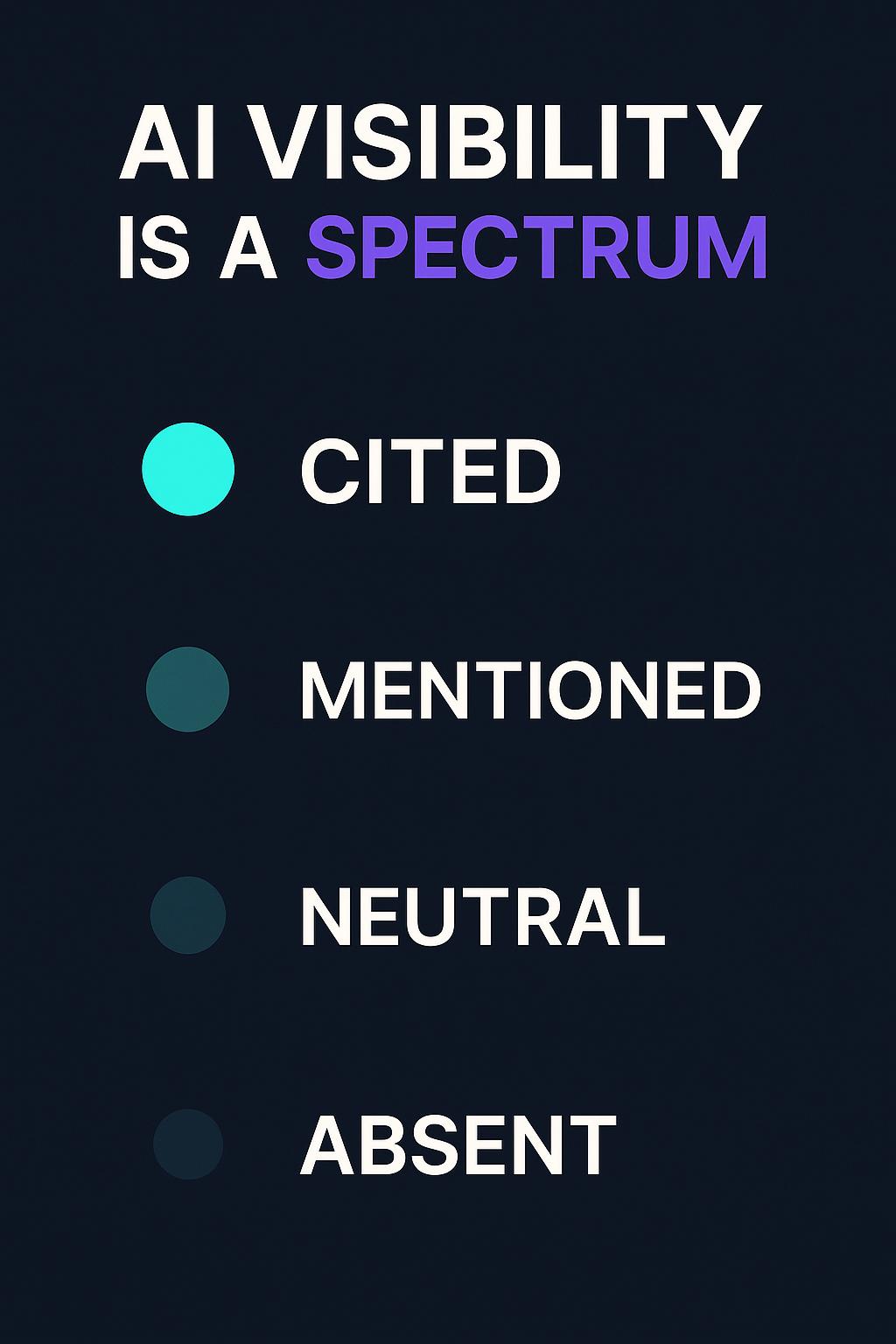
AI visibility refers to how consistently and favourably a brand appears within the generated answers of AI-powered search and answer engines. It is not a single metric. It encompasses several interrelated factors:
- Mention frequency: how often your brand is referenced when relevant questions are asked
- Context quality: whether mentions are accurate, positive, and in the right category
- Citation presence: whether the AI cites your website, content, or authoritative sources when discussing your domain
- Competitive positioning: how your brand appears relative to competitors within the same answers
A brand with strong AI search visibility appears reliably, is described accurately, and is placed in appropriate competitive context. A brand with weak visibility is either absent, mentioned in passing, or — worst of all — described inaccurately.
Why AI Answers Favour Some Brands Over Others
AI language models are trained on large corpora of text from the web, including editorial coverage, reviews, documentation, forum discussions, and social content. When they generate answers, they draw on patterns in that training data and, in many systems, on live retrieval from indexed web content.
This means visibility is earned through a form of authority that has some overlap with traditional SEO but is meaningfully different. The key drivers include:
Authoritative, Consistent Web Presence
AI systems favour brands that appear consistently across credible, independent sources. A brand mentioned in industry publications, referenced in expert discussions, and covered in trade press is more likely to be surfaced than one whose web presence is limited to its own website. Self-published content matters, but third-party validation carries disproportionate weight.
Structured and Semantically Clear Content
Answer engines need to understand what a brand does, who it serves, and why it is relevant to specific queries. Content that clearly articulates these signals — in plain language, with consistent messaging across pages — is more likely to be interpreted correctly. Schema markup, well-structured FAQs, and clear topical authority all contribute.
Topical Coverage and Depth
Brands that publish genuinely useful, in-depth content on the questions their buyers ask are more likely to be treated as authoritative sources. This is not about keyword density. It is about whether your content actually answers the questions AI engines are receiving from users in your category.
These principles sit at the heart of generative engine optimization — the discipline of making a brand more visible and more accurately represented within AI-generated content.
How This Differs from Traditional SEO Visibility
Traditional SEO visibility is primarily about ranking position on a results page. You optimise a page, it climbs to position three for a given keyword, and traffic follows. The feedback loop is reasonably transparent: rankings are measurable, traffic is measurable, and the levers are broadly understood.
AI search visibility is less deterministic and harder to measure through conventional tools. There is no "position one" to chase. The same query, asked across different AI engines, may produce different answers with different brand inclusions. Answers shift as models are updated, as web content changes, and as retrieval indexes are refreshed.
This is why answer engine optimization has emerged as a distinct discipline. It borrows heavily from SEO best practice — technical site quality, content authority, link equity — but adds new considerations: how your brand is described in third-party content, whether your messaging is consistent enough to be accurately synthesised, and whether you appear in the sources AI systems prefer to cite.
Traditional SEO visibility is also largely binary in its user interaction: the user sees a link and clicks, or does not. AI visibility influences the recommendation itself. A brand included positively in an AI answer has already passed a filter that the user trusted enough to query. The conversion implication is significant.
Measuring and Monitoring AI Visibility
Because AI answer engines do not expose APIs that report brand mention data, measuring visibility requires a different approach: systematically querying AI platforms with questions relevant to your brand and category, then analysing the responses.
This is operationally intensive if done manually. It requires a representative set of prompts, consistent execution across multiple platforms, and a structured method for recording and comparing results over time. Platforms such as ChatGPT, Claude, Gemini, and Perplexity each have different answer patterns, citation behaviours, and update cadences, which means a single-platform view gives an incomplete picture.
ApexGEO is a platform built specifically for this problem. It tracks AI brand visibility, brand mentions, historical visibility scores, and recommendations across major AI and search-answer platforms, helping marketers and agencies understand where they stand and where the gaps are.
What Low AI Visibility Costs
The cost of low AI visibility is not always visible in existing analytics. A buyer who asks an AI engine and receives a recommendation for a competitor may never reach your website. There is no failed session to measure, no bounce rate to diagnose. The loss is invisible in standard web analytics because the buyer's journey never touched your domain.
This is the distinctive risk of the current transition period. Brands that are not actively monitoring and improving their AI search presence are accruing a competitive deficit that standard reporting does not capture. The buyers who are most likely to use AI-assisted research are also, typically, the most research-intensive — often the highest-value segment.
The Practical Starting Point
Improving AI search visibility does not require abandoning existing SEO and content strategy. In most cases, it requires extending and clarifying it. Audit your content for topical clarity. Ensure your brand is described consistently and accurately across your own properties. Invest in earning coverage in the authoritative sources AI engines prefer. Structure your content to answer the questions your buyers are actually asking.
Then measure. Without a baseline understanding of how your brand currently appears across AI platforms, optimisation is guesswork. The brands that move fastest will be the ones that establish measurement discipline first, identify the specific gaps in their AI presence, and close them systematically.
If you want to see exactly how your brand currently appears across AI answer engines, run the free snapshot on ApexGEO. It takes a few minutes and gives you a concrete baseline — the starting point for any serious AI visibility strategy. Run your free AI visibility snapshot and see where your brand stands today.
Q: What is AI search visibility?
A: AI search visibility refers to how consistently and accurately a brand appears within the generated answers of AI-powered search and answer engines such as ChatGPT, Claude, Gemini, and Perplexity. Unlike traditional search rankings, it is not a single position metric — it encompasses mention frequency, the accuracy of how a brand is described, citation presence, and how the brand is positioned relative to competitors within AI-generated responses.
Q: How is AI search visibility different from SEO?
A: Traditional SEO focuses on ranking position in link-based results pages, where the user clicks through to a website. AI search visibility determines whether your brand is included in a synthesised answer that the user trusts as a recommendation. There is no single "position" to optimise for, answers vary across platforms, and the factors that drive inclusion — third-party authority, content clarity, consistent messaging — differ meaningfully from classic ranking signals.
Q: Why do AI engines mention some brands and not others?
A: AI engines draw on training data and, in many cases, live web retrieval to generate answers. Brands that appear consistently in credible, independent sources, publish clear and authoritative content on relevant topics, and are described accurately across the web are more likely to be included. Brands with a limited web presence or inconsistent messaging are more likely to be absent or misrepresented.
Q: How can I start measuring my brand's AI search visibility?
A: The most practical starting point is systematic querying — asking AI platforms the questions your buyers ask and recording whether and how your brand appears. Because this is operationally intensive across multiple platforms and over time, dedicated tools such as ApexGEO can track brand mentions, historical visibility scores, and recommendations across major AI answer engines, giving you a measurable baseline to optimise from.