How to Improve Brand Visibility in Perplexity: The 2026 GEO Framework
Perplexity operates as a live-retrieval answer engine that cites its sources. Here is the GEO framework for improving your brand's chance of being cited.
Perplexity has become one of the more consequential places for brand discovery in 2026 — not because of its user volume relative to traditional search, but because of how it changes the discovery experience. When a user asks Perplexity a question, they receive a synthesised answer with numbered citations alongside it. The answer reads like a well-researched summary; the citations appear as evidence. For a brand, being one of those citations is a materially different outcome than appearing on a list of blue links.
This article sets out the generative engine optimization framework ApexGEO uses to improve brand visibility in Perplexity specifically. It covers how Perplexity selects its sources, what makes content retrievable and citable, how entity authority and third-party corroboration shape your chances, and how to build a measurement practice that keeps pace with a retrieval engine operating over live web content.
How Perplexity Works as a Discovery Channel
Perplexity differs from a traditional search engine in a way that matters deeply for brand visibility. A search engine presents a ranked list of pages and lets the user decide which to visit. Perplexity presents a single synthesised answer and selects its own sources to support that answer. The user's attention goes to the answer, not the source list.
This has two practical consequences for brands.
First, citation selection happens upstream of the user. Perplexity's retrieval layer determines which sources are consulted before the answer is composed. If your brand's web presence is not retrievable, well-structured, and clearly authoritative on a given topic, your content may not reach the synthesis step at all — regardless of how good the content itself is.
Second, citations carry implicit endorsement. When Perplexity attributes a claim to a source, it is not simply linking a page; it is indicating that the content was trusted enough to form part of a synthesised answer. Users perceive that differently from a search ranking, where the order is well understood to reflect algorithmic signals rather than editorial judgement.
The implication is that Perplexity visibility is less about competing for a rank and more about qualifying as a trustworthy, legible source. The framework below addresses each dimension of that qualification.
How Perplexity Selects and Cites Trusted Sources
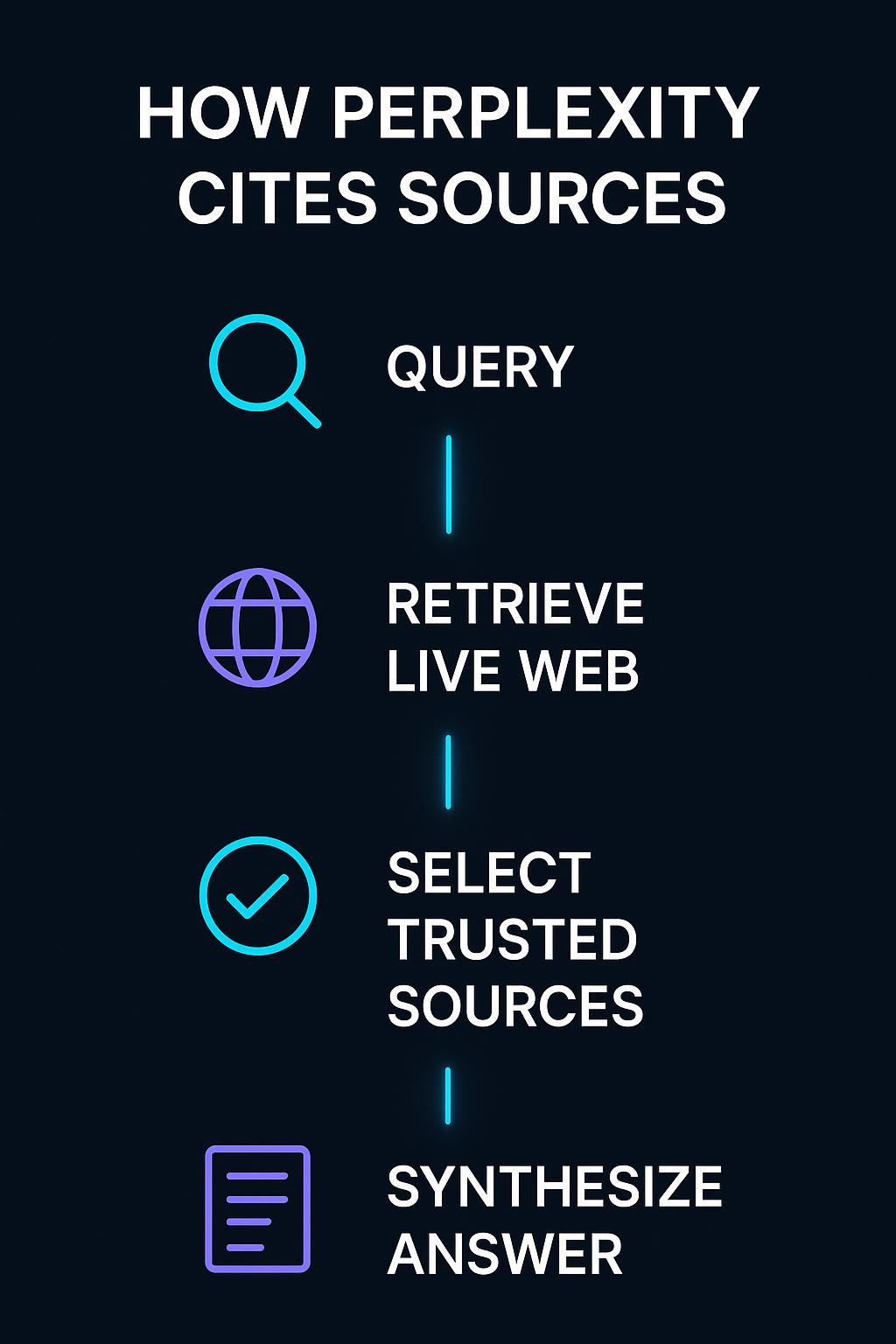
Perplexity retrieves from the live web. Its behaviour reflects principles common to retrieval-augmented generation systems: it identifies sources that are likely to contain accurate, relevant information for a given query, retrieves content from them, and synthesises an answer. Several characteristics make a source more likely to be retrieved and cited.
Topical Alignment and Relevance
The most foundational signal is relevance. Perplexity is selecting content that directly addresses the query being asked. Content that answers specific questions — particularly questions that align with how users phrase queries to an AI assistant — is better positioned than content optimised for broad keyword matching.
This suggests that brands benefit from producing content that directly addresses the questions their audiences are likely to ask. That includes definitional content ("what is X"), comparative content ("how does X compare to Y"), and procedural content ("how do I achieve Z with X") — not as keyword exercises, but as genuine attempts to be the clearest answer to a real question.
Freshness and Live Retrievability
Because Perplexity operates over live web content, freshness matters in a way that differs from indexing-based search. Content that has been recently published or updated, and that is technically accessible to crawlers, is more likely to surface in Perplexity's retrieval pool. This does not mean publishing for the sake of it — thin, frequent content without genuine information value is unlikely to be cited. It means maintaining a programme of substantive, updated content that reflects the current state of your domain.
Authority and Corroboration
A source that is cited, linked to, and mentioned across the web carries a stronger signal than one that stands alone. From Perplexity's perspective, a brand that multiple independent sources describe in consistent terms is a safer choice for a citation than one whose claims appear only on its own properties. This is where the overlap with traditional authority-building — editorial coverage, directory listings, partnerships, earned mentions — becomes directly relevant to answer engine optimization.
Optimising Content for Perplexity Retrieval
Understanding how Perplexity selects sources leads directly to the content decisions that improve your position in its answers.
Structure Content Around Direct Answers
Perplexity is not extracting the most SEO-optimised page on a topic — it is looking for content from which it can extract a clear, accurate answer. Content structured to answer questions directly, with headings that reflect likely query phrasings, is easier to parse and attribute.
Practical signals worth building into your content programme:
- Open sections with a clear, direct statement of the answer before providing context or elaboration
- Use headings that mirror how questions are phrased in natural language, not just how keywords are searched
- Keep factual claims precise and grounded — Perplexity's synthesis is constrained by what it can verify from multiple sources
- Avoid rhetorical structures that bury the answer or require the reader to synthesise across multiple paragraphs
Maintain Factual Precision
Perplexity's synthesis process is more likely to surface content it can cite with confidence. Vague, hedged, or ambiguous content is harder to attribute cleanly. Where your brand has a verifiable position — on pricing, methodology, market coverage, product capabilities — state it clearly and accurately. Do not overstate and do not understate. Precision is a retrievability signal.
Publish Substantive, Updateable Content
The format of content that performs well in Perplexity aligns closely with what performs well in AI visibility more broadly: long-form, topic-level depth that can be updated as circumstances change. Evergreen guides, technical explainers, and definitional content that your team can revise without restructuring are more sustainable investments than one-time campaign content.
Leveraging Schema Markup and Entity Clarity
One of the clearest improvements available to most brands is structural: making the web's representation of your brand unambiguous.
Entity Definition and Consistency
Generative engine optimization rewards entity clarity. A brand that is consistently named, described with consistent attributes, and co-referenced across multiple authoritative sources is more legible to retrieval systems than one whose entity footprint is fragmented or inconsistent.
Practical actions here include:
- Ensuring your brand's legal name, trading name, and product names are used consistently across owned properties, social profiles, and third-party listings
- Maintaining a clear, factually accurate description of what your brand does — one that is stable enough to be consistent across your About page, LinkedIn, industry directories, and press mentions
- Ensuring your website's structured data (Schema.org) accurately describes your organisation type, domain, and primary products or services
Schema Markup for Retrieval Signals
Schema markup does not guarantee citation in Perplexity, but it does reduce the ambiguity that retrieval systems must work through when identifying sources. Well-implemented Organization, Product, Article, and FAQPage schema gives any retrieval system clearer signals about what your content contains and who it is from.
The priority is accuracy over volume. A sparse but accurate schema implementation is more useful than an extensive one that conflicts with your visible content.
| What Perplexity rewards | What it tends to ignore |
|---|---|
| Direct, specific answers to clear questions | Marketing copy without factual anchors |
| Consistent entity naming across the web | Inconsistent brand naming across properties |
| Freshly updated, substantive content | Thin or duplicate content across subdirectories |
| Corroboration from independent third-party sources | Self-referential claims without external support |
| Accurate Schema.org structured data | Keyword-stuffed meta content |
| Clear source attribution and authorship | Anonymous content without organisational signal |
Building Authority Through Third-Party Corroboration
The third-party signal is, for most brands, the hardest to manufacture and the most durable when earned. Perplexity — like all retrieval-augmented systems — is more confident citing a source when that source is itself referenced by other credible sources.
What Corroboration Looks Like in Practice
Corroboration is not simply backlinks. It is the pattern of independent sources describing your brand in consistent, relevant terms. That pattern develops through:
Editorial coverage — Being mentioned in industry publications, news coverage, and specialist media that cover your domain creates a retrievable record of third-party recognition. The most valuable coverage includes factual claims about your brand — what it does, who uses it, what distinguishes it — because those claims are what retrieval systems can surface.
Directory and aggregator listings — Industry directories, review platforms, and professional databases are crawlable sources that Perplexity's retrieval layer can access. Consistent, accurate listings across relevant directories build the entity footprint that retrieval systems look for.
Partner and integration mentions — When established brands in your ecosystem mention your product or service in their documentation, case studies, or partner pages, those mentions contribute to the corroboration signal. These are among the more credible third-party sources because the mention appears in a context that reflects an actual relationship.
Community and forum presence — Questions answered in relevant forums, communities, and Q&A platforms are often directly retrievable by Perplexity. A well-informed, helpful presence in the communities where your audience asks questions is both a brand signal and a retrieval opportunity.
The common thread is that each of these channels creates a publicly accessible, crawlable record of your brand's authority in a relevant domain. The more consistent that record, the more confidently a retrieval system can surface you.
Auditing and Monitoring Your Perplexity Presence
The nature of a live-retrieval engine is that your visibility shifts continuously. A new piece of content from a competitor, an update to your own pages, or a change in how a query is typically phrased can all affect whether and how you appear. This makes monitoring a structural requirement rather than an optional enhancement.
What to Measure
Perplexity visibility is not captured by traditional search reporting. The signals worth tracking are:
- Citation frequency — how often your brand is cited in answers to queries relevant to your domain
- Citation context — the framing and sentiment of mentions when they occur; presence is not always positive presence
- Competitive citation share — which brands are appearing in the same answer contexts where you appear or where you are absent
- Query coverage — across the range of questions your audience asks, how broadly is your brand covered versus absent
These signals require dedicated instrumentation. ApexGEO's MONITOR surface tracks brand mentions and citation patterns across AI answer engines including Perplexity, ChatGPT, Claude, Gemini, Grok, DeepSeek, and Microsoft Copilot — providing a structured view of visibility that sits entirely outside traditional search reporting.
The AUDIT Surface as a Readiness Check
Before monitoring can tell you whether you are improving, the AUDIT surface can identify the structural conditions that are limiting your retrievability today. ApexGEO's AUDIT analyses technical site health, content structure, entity clarity, and schema implementation — and the Smart Recommendations Engine prioritises findings by expected impact, so teams can direct effort toward the changes most likely to move the needle.
This readiness-before-monitoring sequence matters because monitoring a sub-optimal presence generates data that reflects a starting state rather than a ceiling. The AUDIT pass establishes the baseline and surfaces the structural work; the MONITOR tracks whether that work translates into citation improvement over time.
Iteration Cadence
Perplexity visibility does not move on the same cadences as search rankings. Content improvements can influence retrieval relatively quickly; authority-building through third-party corroboration takes longer. A productive iteration cadence combines a monthly content review — identifying gaps in your direct-answer coverage — with a quarterly authority audit — reviewing the distribution and consistency of third-party mentions across crawlable sources.
The measurement discipline is what distinguishes a programme from a set of ad-hoc improvements. Without a structured view of citation patterns over time, it is difficult to attribute visibility changes to specific actions or to identify which channels are contributing most to your Perplexity presence.
Where to Start
For most brands, the highest-leverage starting point is a clear-eyed view of the current state. Before deciding which content to create, which schema to implement, or which third-party channels to pursue, understanding where you currently appear — and where you are absent — gives every subsequent decision a sharper foundation.
If you want to see how your brand is currently performing across AI answer engines including Perplexity, the free AI visibility snapshot from ApexGEO provides an initial view of where you are being cited, where competitors are appearing in your place, and where the largest gaps exist. It is a starting point, not a conclusion — but it is a more grounded starting point than beginning a GEO programme without any measurement in place.
Q: Does Perplexity use the same signals as Google when selecting sources?
A: Not exactly. Perplexity operates as a retrieval-augmented generation system that draws from live web content, whereas Google's ranking algorithm is built on a distinct set of historical signals developed over decades. That said, there is meaningful overlap in the underlying conditions that help a source perform in both: genuine topical authority, accurate structured data, a strong external backlink and mention profile, and technically accessible, well-structured content. Brands with a mature SEO programme often find they have a head start in Perplexity visibility because the foundations carry over, even if the specific signals are not identical.
Q: How quickly can visibility in Perplexity improve after making content changes?
A: It depends on the type of change. Structural improvements to page content — clearer headings, more direct answers, better schema — can influence retrieval relatively quickly once the updated content is crawled. Authority-building through third-party corroboration is slower, because it involves earning mentions and coverage from independent sources rather than editing owned properties. A realistic programme treats content structure as the near-term lever and authority development as the medium-to-long-term investment, while monitoring tracks both.
Q: Should I create Perplexity-specific content or adapt existing content?
A: Adapt existing content first. Most brands have substantive content that could perform better in retrieval contexts with relatively modest structural changes — clearer opening answers, more direct headings, updated factual claims, better schema. Creating entirely new content is warranted when there are genuine gaps in your topic coverage — questions your audience is asking that your current content does not directly address. Starting with adaptation is more efficient and surfaces the structural patterns worth carrying into new content production.
Q: Is schema markup necessary for Perplexity visibility?
A: Not strictly necessary, but meaningfully useful. Schema markup reduces the ambiguity that retrieval systems must resolve when identifying what a piece of content is about and who produced it. A well-implemented Organization or Article schema gives Perplexity's retrieval layer cleaner signals about your content without requiring the system to infer your brand's identity from surrounding text. The priority is accuracy — a small, accurate schema implementation is more useful than a large one that contradicts your visible content or is implemented inconsistently across your site.
Q: How does Perplexity visibility relate to visibility in other AI answer engines?
A: The foundations overlap considerably. Entity clarity, authoritative content, third-party corroboration, and well-structured direct answers are signals that help across AI answer engines — including ChatGPT, Claude, Gemini, Grok, DeepSeek, and Microsoft Copilot. Perplexity is distinctive in its heavy reliance on live web retrieval and its explicit citation UI, which makes retrievability and source credibility particularly salient there. Other engines weight training data, knowledge graph signals, and retrieval differently, which is why monitoring visibility across multiple platforms gives a more complete picture than optimising for any single engine.
Q: How do I know if the changes I'm making are actually improving my Perplexity presence?
A: You need to measure it directly. Perplexity visibility does not appear in traditional search console data, rank trackers, or web analytics. The only way to know whether your citation frequency is improving — or whether a competitor has gained ground in your query space — is to monitor AI-generated answers directly over time. ApexGEO's MONITOR surface tracks this across the major AI answer engines, so changes in citation frequency and context are visible as a trend rather than as an occasional manual check.
Q: Can a small brand realistically appear in Perplexity answers in a competitive category?
A: Yes, though the path is different from competing for a top-three Google ranking against dominant incumbents. Perplexity's retrieval is query-specific — a small brand with genuinely authoritative, clearly structured content on a specific sub-topic can be cited in answers to that query even if it is not a recognised category leader overall. The leverage point is depth and specificity: being the clearest, most trustworthy available source for a specific type of question, rather than trying to compete on broad category authority. Third-party corroboration in relevant specialist communities or publications matters more here than general domain authority.