AEO Grader: How to Audit and Score Your Brand's Visibility in AI Search (2026)
An AEO grader tells you how well your site is structured for AI answer engines — but a one-off score without ongoing monitoring misses most of what matters. Here is what to measure and how to act on it.
There is a growing category of tools that promise to tell you, in a single number, how ready your brand is for AI visibility. The category is sometimes called an "AEO grader", sometimes an "AI readiness score", sometimes an "answer engine audit". The names vary; the appeal is the same. Marketers want to know where they stand.
The appeal is well-founded. Answer engine optimisation is no longer a niche concern. When a prospective customer asks ChatGPT, Claude, Gemini, Perplexity, Grok, or DeepSeek which solution to use in your category, the brand that is cited — or conspicuously absent — experiences a real discovery outcome. Measuring readiness for that outcome is a legitimate priority.
The problem is not the measurement instinct. The problem is what a simple, one-off grade tends to leave out: the ongoing monitoring layer that tells you what is actually happening inside AI responses right now, and the ranked action queue that tells you what to do about it. A grade without those two elements is a starting point that has been mistaken for a destination.
This article explains what a credible AEO audit actually measures, why the grade alone is insufficient, what a technical improvement roadmap looks like in practice, and how continuous monitoring connects the audit to a loop that compounds over time.
What an AEO Grade Actually Measures
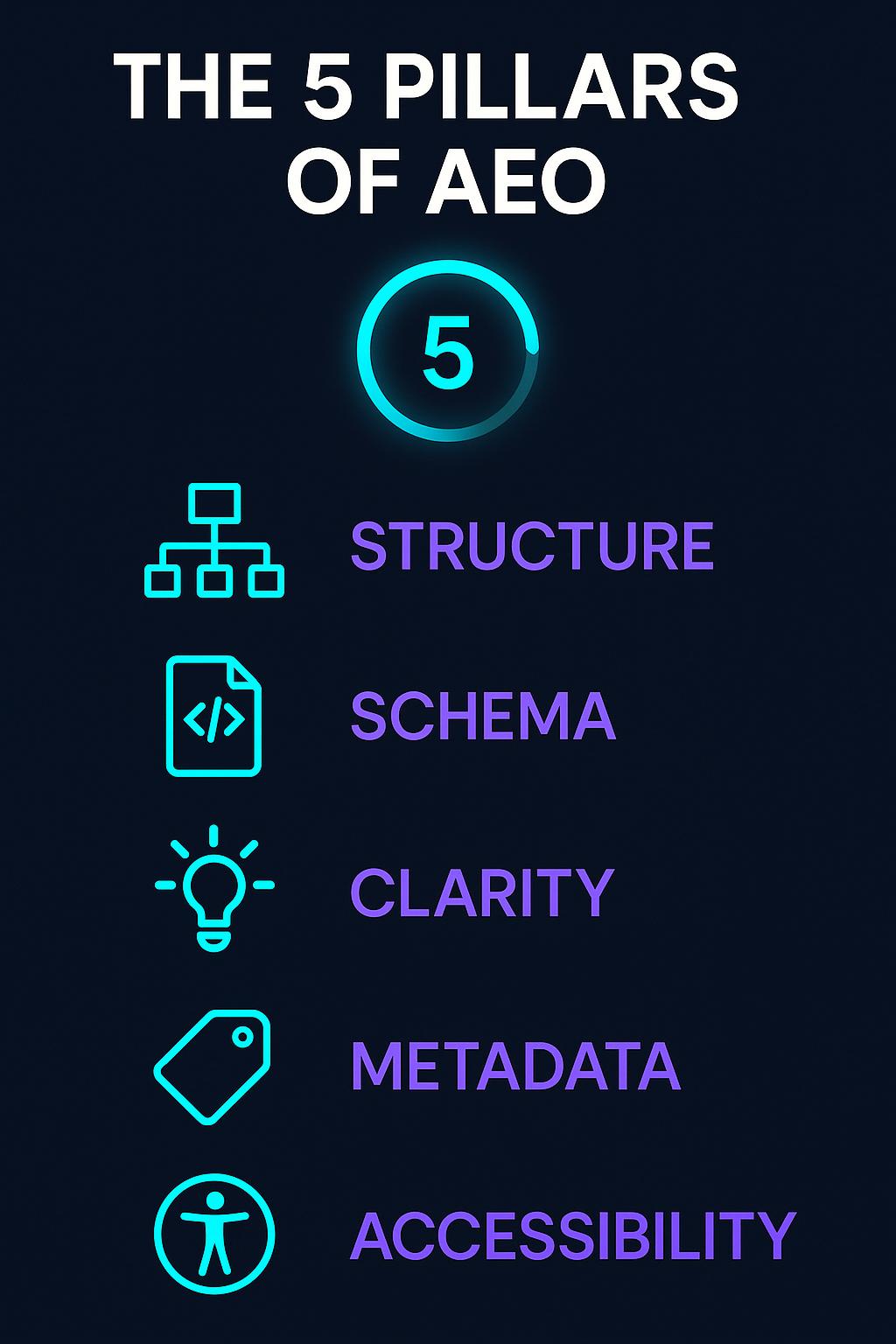
A meaningful AEO audit is not a single signal. It is a composite across five distinct technical pillars, each measuring a different dimension of how AI systems can read, interpret, and surface your content.
Structure
Structure refers to how your pages are organised for machine consumption. AI answer engines — particularly those with retrieval-augmented generation layers — parse pages looking for clear hierarchical signals: logical heading sequences, consistent layout patterns, and content blocks that can be cleanly extracted as discrete answers.
Pages that bury key information inside dense prose, that use headings inconsistently, or that lack a clear navigational hierarchy are harder for AI systems to parse. The audit here looks at heading architecture, content segmentation, and whether the page organisation supports extraction or fights it.
Schema
Schema markup is structured data vocabulary — primarily Schema.org — that allows a page to explicitly declare its content type and the entities it describes. An organisation page that correctly implements Organization schema with name, url, sameAs, and description properties is giving an AI system a machine-readable declaration of who you are and what you do. Without it, the system must infer those facts from prose, which introduces ambiguity and compression losses.
The audit examines which schema types are present, whether they are implemented correctly, and whether they cover the highest-priority page types — homepage, product or service pages, FAQ content, and author/entity pages.
Clarity
Clarity is the prose dimension of AEO readiness: how precisely and unambiguously your content describes your brand, its products, its category position, and its differentiation. AI systems are language models. They learn entity relationships from patterns in text. A brand described inconsistently across its own pages — different names, different descriptions, conflicting claims about what the product does — is harder to represent accurately in a synthesised answer.
The clarity audit looks at entity naming consistency, definition quality, whether the site answers the questions buyers actually ask in language that is extractable, and whether technical or category claims are substantiated rather than asserted.
Metadata
Metadata covers the page-level signals that AI crawlers and retrieval systems use before they parse body content: title tags, meta descriptions, canonical declarations, Open Graph data, and structured JSON-LD blocks. These signals function as front-matter for AI ingestion. A well-formed title that accurately describes the page's primary entity and purpose reduces the chance of a language model misclassifying or misattributing the content it finds there.
The audit checks completeness, accuracy, and consistency of metadata across the primary pages an AI crawler would index from your domain.
Accessibility
Accessibility in an AEO context is not simply about human users — though it matters there too. Content that requires JavaScript to render, that hides behind modals or paywalls, that is embedded in non-parseable formats, or that loads conditionally is less accessible to AI crawlers regardless of its quality. Images that carry meaning without descriptive alt text are invisible to language models. Tables without clear header declarations become ambiguous data.
The accessibility pillar assesses crawlability from an AI retrieval perspective: whether the content that matters is in a form that can be reliably extracted, not just displayed.
Why a One-Off Grade Is Insufficient
An audit across these five pillars gives you a useful snapshot. It tells you whether your current technical foundation supports AI-readiness or undermines it. That is worth knowing.
What it cannot tell you is what is actually happening inside AI responses right now — and that gap matters more than it might initially appear.
AI answer engines are not static systems. They update model weights, retrieval indices, and citation policies on irregular schedules. A Perplexity citation that appeared reliably in responses three months ago may have been displaced by a competitor whose content better answers the query now. A Gemini response that mentioned your brand neutrally in January may describe it more favourably — or less — after a retrieval layer update.
These shifts happen independently of anything you control on your own site. They are driven by changes to competitor content, by shifts in how AI systems weight different source types, and by the accumulating effect of how your brand is described across the accessible web — not just your owned domain.
A site that scores well across all five audit pillars is better positioned to receive citations. It is not guaranteed to receive them, and a static grade has no visibility into where it currently stands, whether its competitive position is strengthening or weakening, or which AI engines are mentioning it versus which are silent.
That is the function of ongoing monitoring: tracking brand mentions across AI platforms over time, detecting trend changes before they become strategic problems, and giving the audit a real-world feedback signal to validate against. A grade without monitoring is a hypothesis about performance. Monitoring is what turns it into evidence.
ApexGEO's MONITOR surface tracks mentions across ChatGPT, Claude, Gemini, Perplexity, Grok, DeepSeek, and Microsoft Copilot — covering the engines where buyers in most categories are currently directing research queries. The combination of audit and monitoring is what makes the overall programme defensible rather than speculative.
How to Improve an AEO Grade: A Technical Roadmap
Once the five-pillar audit has identified where the gaps are, the improvement work follows a predictable priority order. The actions below are sequenced from highest expected impact to lowest — not because lower-priority items are unimportant, but because technical constraints mean some foundations must be in place before higher-level improvements compound.
1. Establish entity clarity first
If your brand's entity definition is ambiguous — inconsistent naming, vague or contradictory descriptions, no sameAs references to authoritative external sources like a Wikidata entry or a prominent industry directory listing — fix this before anything else. AI systems reason about entities. An ambiguous entity is harder to surface accurately regardless of how well the surrounding technical infrastructure performs.
Concrete actions: standardise your brand name across all pages and metadata, write a precise one-paragraph definition of what your brand is and does that is consistent everywhere it appears on your site, add sameAs properties to your Organization schema pointing to external authoritative sources, and ensure your homepage's <title> and <meta name="description"> accurately reflect the same entity definition.
2. Implement and validate structured data
Once entity clarity is established, structured data markup ensures that clarity is machine-readable. Prioritise in this order: Organization schema on the homepage, WebPage and BreadcrumbList on key service or product pages, FAQPage schema on any page that answers specific questions, and Article or BlogPosting schema on editorial content.
Validate all implementations against Google's Rich Results Test and Schema.org's official validator — not because Google is the primary target here, but because these tools surface implementation errors that would cause any machine reader to misparse the data.
3. Restructure content for answer extraction
Review your highest-priority pages against the question: can an AI system extract a clean, self-contained answer to a specific buyer question from this page? If the answer to your category's most common query is buried in paragraph four of a dense introduction, restructure it. Front-load definitions. Use subheadings that are themselves answerable questions. Break long paragraphs into shorter ones where each paragraph makes a single clear point.
This does not mean sacrificing depth. It means organising depth for machine extraction, which is compatible with — and usually improves — human readability as well.
4. Build authority and corroboration signals
A technically clean site that is not corroborated by external sources is less likely to be surfaced in AI responses than one with consistent external references. This means earning genuine editorial coverage in your category, building presence on authoritative sources that AI systems weight (industry directories, Wikipedia where appropriate, reputable media coverage), and ensuring that the way you are described externally is consistent with the entity definition on your owned properties.
This is the dimension that generative engine optimisation emphasises: topical authority and external corroboration that make a brand's entity definition more legible to language models. It takes longer to build than technical fixes but has compounding returns because corroboration accumulates.
5. Resolve accessibility and crawlability issues
Finally, ensure the content that matters is accessible to non-browser crawlers. Audit critical pages with JavaScript disabled to confirm body content renders. Add descriptive alt text to images that carry informational content. Ensure data tables have proper <th> headers. Remove or minimise content that is only accessible after user interaction.
Static Grade vs Continuous Monitoring: What Each Gives You
| Static one-off score | Continuous AI-visibility monitoring | |
|---|---|---|
| What it captures | Technical readiness at a point in time | Live mention frequency, sentiment, and share of voice across AI engines |
| Engine coverage | Analyses your site's structure and metadata | Tracks real responses across ChatGPT, Claude, Gemini, Perplexity, Grok, DeepSeek, Copilot |
| How fresh | Stale as soon as AI systems update | Refreshed on an ongoing cadence to detect trend changes |
| Tells you what to fix? | Yes — identifies structural and technical gaps | Yes — surfaces which content and authority signals are affecting live mentions |
| Best for | Establishing a baseline and prioritising technical work | Measuring whether improvements are working and detecting competitive shifts |
The two are complementary, not alternatives. A one-off audit without monitoring gives you a diagnosis with no ongoing feedback. Monitoring without an audit gives you a performance signal with no structural explanation. Used together, the audit defines the improvement programme and monitoring validates whether it is working.
How ApexGEO Turns the Grade Into Ranked, Expected-Impact Fixes
Knowing your score across five pillars is necessary but not sufficient. The question that determines whether an AEO programme makes progress is: given constrained time and resource, which fix should happen first?
ApexGEO's AUDIT surface analyses a site across the five pillars described above and feeds the results into the Smart Recommendations Engine. The Smart Recommendations Engine ranks each identified issue by its expected impact on the overall score — not alphabetically, not by pillar order, but by the combination of severity and leverage. A schema gap on a high-traffic product page ranks above a metadata issue on a low-priority archive page, even if both are technically "schema" and "metadata" issues respectively.
The output is a prioritised action queue rather than a flat list of findings. Each recommendation specifies what is wrong, which pillar it affects, and why addressing it is expected to move the score by more than other open issues. Teams with limited bandwidth can work down the queue in order and be confident they are addressing the highest-leverage items first.
The AUDIT grade also becomes more meaningful when set alongside the MONITOR data. If a pillar score improves but brand mentions do not increase, that tells you something about where the real constraint lies. If mentions improve ahead of a pillar fix, that tells you the fix may be less urgent than it appeared. The connection between the technical audit and the live monitoring surface is what makes the overall programme empirically grounded rather than speculative.
Start With a Baseline
The first step in any AEO programme is understanding where you currently stand. Before prioritising improvements, before adjusting content strategy, before allocating development time to structured data work — measure the baseline.
ApexGEO offers a free AI visibility snapshot that shows how your brand currently appears across the core AI answer engines: where you are being mentioned, where you are absent, and which gaps are largest relative to your category. The snapshot covers both the technical audit signals and the live monitoring layer, giving you a starting point that is grounded in what is actually happening in AI responses today rather than what a static score predicts.
It is a directional signal, not a guarantee of what comes next. But it is the most honest starting point for a programme that needs to be driven by evidence rather than approximation.
Get your free AI visibility snapshot and use it as the baseline from which your improvement loop begins.
Q: What is an AEO grader and how is it different from an SEO audit tool?
A: An AEO grader assesses how well a site is structured for AI answer engines — measuring technical pillars like schema implementation, content clarity, metadata quality, and crawl accessibility from the perspective of language model retrieval systems. A traditional SEO audit tool measures performance in keyword ranking systems: backlink profiles, crawl health, Core Web Vitals, and on-page keyword signals. The two overlap on technical fundamentals like structured data and crawlability, but diverge on what counts as success. An SEO audit targets search result positions; an AEO audit targets how legible your brand entity is to the AI systems that synthesise answers from the web.
Q: Can a perfect AEO score guarantee my brand will be cited in AI responses?
A: No. An AEO score is a directional signal about technical readiness, not a commitment about what any AI engine will do with your content. AI systems are probabilistic; their responses vary by query phrasing, model version, user context, and competitive alternatives present in their training data and retrieval indices. A high score improves the conditions under which your brand is likely to be surfaced. It does not control the output. Any tool or vendor that presents a high AEO score as a citation guarantee is misrepresenting how these systems work.
Q: How often should I re-run an AEO audit?
A: A full technical audit is worth running at the start of an optimisation programme, after significant site changes — new page templates, schema restructuring, major content overhauls — and roughly quarterly as a health check. Between audits, continuous monitoring of live AI mentions is more actionable than repeated static audits, because it captures changes driven by AI engine updates and competitive dynamics that your owned properties did not cause. The audit and the monitoring serve different functions on different cadences.
Q: Which of the five AEO pillars should I address first?
A: The Smart Recommendations Engine within ApexGEO ranks issues by expected score impact rather than by pillar, so the right answer depends on the specific gaps your audit surfaces. As a general rule, entity clarity issues — inconsistent brand naming, missing Organization schema, contradictory descriptions — have the widest downstream effect because they affect how AI systems recognise and represent your brand entity across all query types. Fix those before addressing localised issues on individual pages.
Q: Is structured data still important when AI systems can understand natural language?
A: Yes, and arguably more so. While large language models can infer meaning from prose, structured data provides explicit, unambiguous declarations that reduce the inference burden. An Organization block with a precise description and sameAs references is harder to misinterpret than a paragraph making the same claims in prose. As AI systems are deployed at scale across billions of queries, the cost of ambiguity compounds. Structured data is a direct investment in reducing that ambiguity.
Q: Does AEO only matter for brands in technology or B2B categories?
A: No. Answer engine optimisation is relevant for any category where buyers use AI systems to research decisions — which now spans professional services, consumer products, travel, financial services, health, and well beyond. The specific prompts that drive AI visibility differ by category, but the underlying audit pillars — entity clarity, structured data, answer-shaped content, authority signals — are universal. ApexGEO tracks visibility globally across categories, not only in technology or English-language markets.
Q: How does continuous monitoring change the way I use the AEO grade?
A: Monitoring turns the grade from a static observation into part of a feedback loop. When you implement a schema fix or restructure content, monitoring tells you whether brand mentions shifted in the weeks that follow. When your grade holds steady but mentions decline, monitoring flags that a competitive or engine-level change is the likely cause rather than anything on your site. The grade sets the direction for technical work; monitoring validates whether that work is translating into the real-world outcome — more frequent, more favourable brand mentions in AI-generated answers — that the programme is designed to produce.